Disinfection measurement and monitoring solutions are of paramount importance in applications such as drinking water treatment, industrial water processing, and swimming pool management. Their primary objective is to ensure safe, consistent, and cost-effective water quality, thereby safeguarding human health and protecting system infrastructure.
Depending on the environmental conditions and process requirements, different disinfectants are selected to achieve optimal effectiveness and system performance.
Chlorine and chlorine dioxide are among the most commonly used disinfectants today, valued for their strong effectiveness and wide applicability in water treatment plants, cooling systems, bottle-washing lines, and swimming pools.
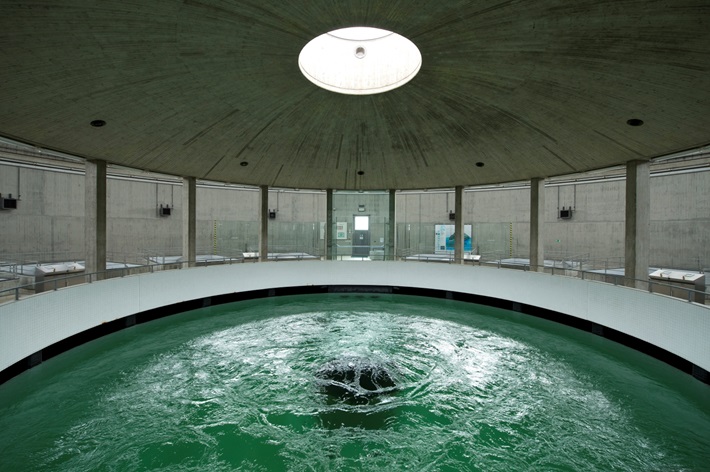
Ozone is commonly used in water treatment plants due to its strong oxidizing capability, which effectively eliminates microorganisms and organic impurities prior to disinfection..
Bromine is an ideal choice for saline environments such as ballast water systems on ships, aquaculture facilities, or desalination plants, thanks to its stability and effectiveness under high pH conditions.
Chlorine sensors are among the most commonly used instruments for measuring disinfectants (including free chlorine, chlorine dioxide, total chlorine, free bromine, and ozone). They enable precise, continuous, and reliable monitoring of disinfectant concentrations, ensuring that water treatment processes consistently meet safety standards, comply with environmental regulations, and optimize operational costs.
Endress+Hauser’s chlorine sensor and transmitter systems are applied across a wide range of industries — from drinking water and swimming pools to wastewater, industrial recirculating water, and seawater – providing reliable protection for people, equipment, and the environment.
Measuring principle of Chlorine sensors
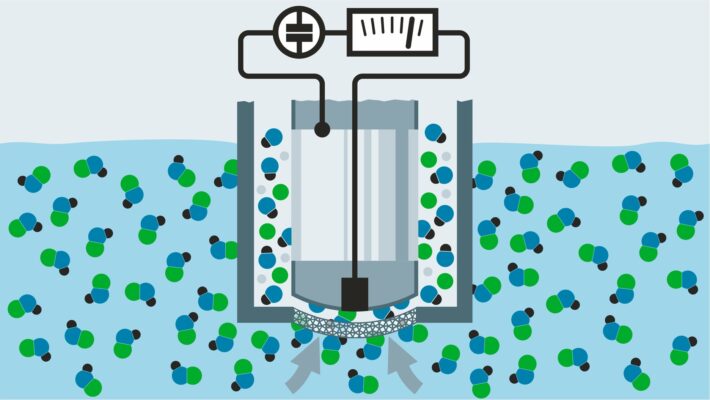
Chlorine sensors operate based on the amperometric principle. They consist of a working electrode and a counter electrode, separated from the environment by a semi-permeable membrane containing an electrolyte solution.
For chlorine dioxide (ClO₂), the molecules diffuse through the membrane and are reduced at the working electrode, generating a current proportional to the concentration of chlorine dioxide in the solution.
For free chlorine, hypochlorous acid (HOCl) diffuses through the membrane and reacts at the electrode. Since the concentration of HOCl depends on pH, the sensor typically integrates pH measurement to compensate for errors and ensure accuracy.
For free bromine, the operating principle is similar to that of free chlorine measurement; however, the sensor is better suited to perform reliably in environments with high alkalinity (high pH).
For total chlorine, the sensor detects both hypochlorous acid (HOCl) and chloramines, providing a comprehensive overview of the residual disinfectant levels in wastewater or recycled water.
This principle enables the sensor to operate stably across a wide pH and temperature range, while maintaining accurate measurement signals and rapid response times.
Measuring Principle of Chlorine Sensors Based on the Electrochemical Method
Advantages of Endress+Hauser Chlorine sensors
✅ Comprehensive solution for all disinfection applications: chlorine, chlorine dioxide, bromine, and ozone.
✅ High accuracy and long-term stability thanks to robust sensor design with minimal maintenance requirements.
✅ Flexible design: suitable for installation in pipelines, tanks, or flow assemblies.
✅ Seamless integration with Liquiline transmitter units — supporting multi-channel, multi-parameter configurations.
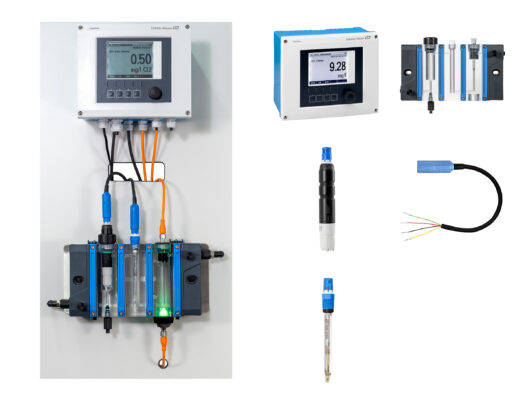
✅ Pre-configured integrated measurement systems (monitoring panels) available, including sensors, transmitters, test valves, filters, and accessories—ready for immediate operation.
Applications of Endress+Hauser Chlorine sensors
Drinking water: ensuring appropriate disinfection levels in compliance with safety standards.
Cooling systems and cooling towers: controlling chlorine dioxide to prevent microbial growth and scaling.
Desalination plants, seawater applications, and aquaculture: monitoring bromine concentrations in saline water.
Wastewater treatment plants: monitoring total chlorine in discharge water to ensure compliance for reuse or safe discharge.
Chlorine sensors paired with Liquiline transmitters provide a comprehensive solution for water disinfection monitoring, ensuring safe water quality, stable operation, regulatory compliance, and minimized maintenance costs.
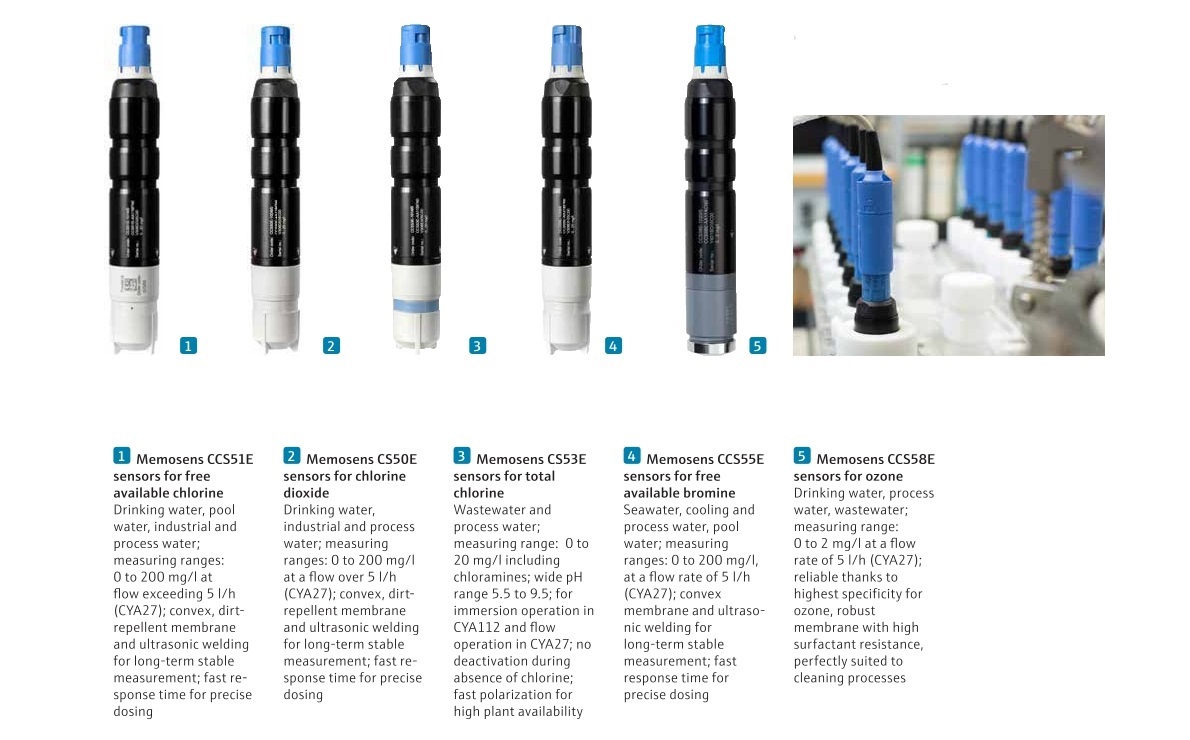
Portfolio of Endress+Hauser Chlorine sensors
Installation of Chlorine sensors
Chlorine monitoring system installed on a panel
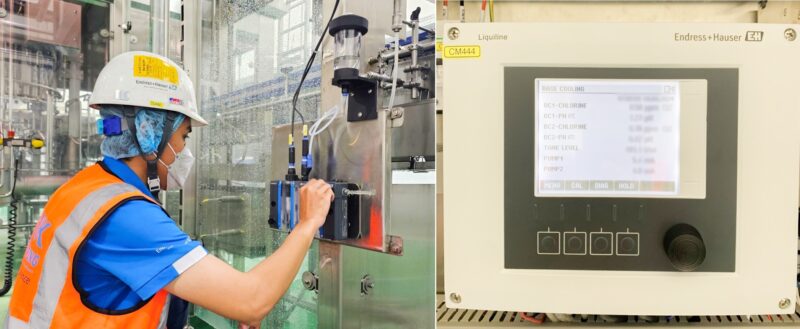
Continuous chlorine monitoring system overseeing the chlorine dosing process in a beverage manufacturing plant.